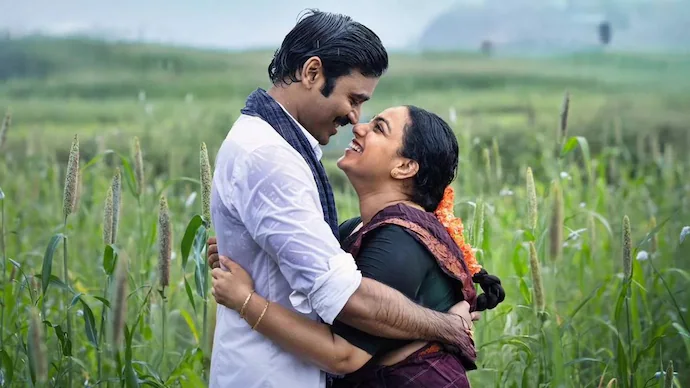
Nooru Saami Review: A Tender, Quietly Defiant Drama Carried by a Luminous Swasika

In a season crowded with spectacle, Nooru Saami arrives almost on tiptoe, a small, unhurried village drama with no grand canvas and no appetite for noise, and it lingers in the mind far longer than films many times its size. Directed by Sasi and produced under the Vijay Antony Film Corporation banner, it takes a deceptively simple question, may a widowed mother wish for happiness of her own, and builds from it a humane, quietly defiant portrait of a woman reclaiming her dignity. It is, by some distance, one of the most affecting Tamil dramas of the year, and if it asks a measure of patience in its opening stretch, it repays that patience richly.
The story belongs to Selvi, a young widow raising two sons alone in a conservative, caste-bound village that is neither kind nor forgiving. The film’s title translates as “A Hundred Gods,” and the irony is pointed: in a community that venerates so much, it can spare so little grace for a woman who dares to want a life of her own. Selvi has learned to make herself small, and the film is filled with little observed details that convey the daily arithmetic of her self-erasure, the forehead kept bare at home and the bindi applied in secret at the office, the clothes chosen to help her merge into the background, the instinct to hide behind a door when a happy procession passes in the street. When she lets slip, almost casually, that she might wish to marry again, her sons react as though she has confessed to a crime, and the household, and soon the village, is thrown into a tailspin.
At the centre of it all is Swasika, in a performance that is nothing short of revelatory. She carries the film on her shoulders with breathtaking ease, charting Selvi’s torment, resilience and tentative hope without a single false note. It is a portrayal built on restraint rather than display, on the things left unsaid, and it ranks among the finest pieces of acting in recent Tamil cinema. The widespread consensus that this is a career-best turn feels entirely earned; one simply cannot imagine the film without her.
She is matched, late in the film, by Vijay Antony, who steps into the second half as Ezhumalai, a gentle, philosophically inclined sugarcane worker and widower. It is a surprisingly alive, rejuvenated turn from the actor-composer, and his scenes with Swasika supply some of the film’s most quietly beautiful passages. Sasi makes middle-aged love look genuinely lovely, locating its romance not in grand declarations but in small, telling gestures: a man who does not want his partner to suffer in the kitchen, who embraces her children as his own, who beams when her son calls him appa, who thinks nothing of walking down a lane carrying two ice candies. Ezhumalai is dignity personified, and through him the film argues, without ever raising its voice, that companionship and tenderness are not the preserve of the young.
Sasi’s direction is the film’s other great asset. He is among Tamil cinema’s most reliable chroniclers of rural life, and his feel for the textures and rhythms of the village gives Nooru Saami its lived-in authenticity. Crucially, he refuses the easy route of melodrama, trusting his audience to feel the weight of the story without being lectured to. The film’s social message, that a woman’s desires and dignity are her own, lands not through a speech but through accumulated observation. There is a caste dimension threaded through the drama too, and it is telling that Balaji Sakthivel, the film-maker behind the seminal Kaadhal, is cast here as a meddling custodian of patriarchy, a man for whom the policing of a woman’s choices is a lifelong vocation. Through him the film makes its sharpest point: the impulse to “protect honour” recognises no limit of age, and would crush any woman who dares to think or speak for herself.
The structure unfolds in two movements, and the second is markedly stronger than the first. The early portion concerns the sons wrestling down their egos to accept that their mother’s happiness might matter more than their pride; the latter, and far more compelling, half turns to the infinitely harder task of making that happiness real against a community primed to take offence. It is here, as the stakes sharpen and Ezhumalai enters, that the film truly comes alive, building genuine investment in how Selvi’s journey will resolve.
If there is a recurring criticism in the consensus, it concerns that first half, which can feel sluggish and repetitive, circling the same conflict between mother and sons until one begins to wish the story would move on. The screenplay is, in places, uneven, and one or two supporting characters feel underused, their potential not quite realised. These are real reservations, and they explain why the film’s commercial opening was modest, with quiet early footfalls for a Sasi and Vijay Antony collaboration. This is content-driven cinema rather than a crowd-pleasing spectacle, and it has had to build its audience patiently, through word of mouth and the warmth of family viewers, rather than through opening-day clamour.
Yet these are quibbles set against a work of real sincerity and feeling. Nooru Saami is a small film that punches well above its weight, a quietly subversive refresh of the village-drama genre that earns its emotional payoff honestly. It treats its characters with respect, its subject with care, and its audience with trust, and it is anchored by a performance from Swasika that deserves to be remembered at the year’s end. Those willing to meet it on its own gentle terms, and to forgive a slow beginning, will find a deeply moving film about second chances, dignity, and the radical idea that a mother’s life belongs, first and last, to herself.

Parimala and Co Review: A Golden Cast Trapped Inside a Half-Cooked Caper

With Love Review: A Soft, Sincere Tamil Romance With Warmth and Memory

Parasakthi Review: A Fierce Subject Rendered Strangely Cold
Youth Review: A One-Man Debut That Proves Heart Can Outsell Star Power
Kara Review: Dhanush and Vignesh Raja Mount a Gritty Period Heist That Promises More Than It Delivers
Thalaivar Thambi Thalaimaiyil Review: Jiiva Anchors a Warm, Wickedly Observed Village Satire

Love Insurance Kompany Review: An Average, Overstuffed Romantic Sci-Fi That Has Ideas but Not Enough Spark

Thaai Kizhavi Review: A Rich, Rooted Rural Drama With Wit, Soul, and a Fiercely Unconventional Protagonist

Karuppu Review: Suriya and RJ Balaji Conjure a Rousing, Big-Hearted Spectacle