Uyir: Malayalam movie review
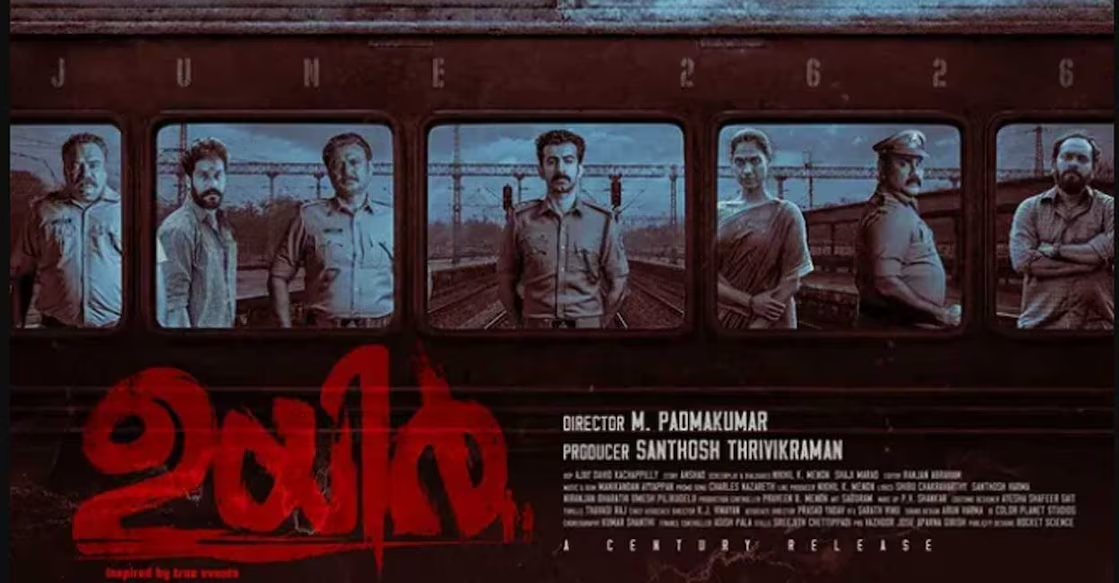
At first glance, Uyir appears to follow a familiar template: a young police officer, a disturbing death, a case that slowly opens into something larger, and a protagonist whose personal pain shadows every professional move. That familiarity is not a weakness by itself. In fact, the film uses that structure to build a quiet, methodical mood, allowing the investigation to unfold with the patience of a procedural rather than the swagger of a thriller.
The story centers on Ajeeb, a probationary sub-inspector who is emotionally marked by childhood loss. That background matters because the film is less interested in making him a clever detective than in showing how he looks at suffering. Roshan Mathew plays that hesitation well; his performance is controlled, soft-spoken, and observant, which suits a character who is constantly absorbing more than he says aloud. The result is a lead performance that feels lived-in rather than performed for effect.
The film’s strongest stretches come early, when the investigation is still expanding and each new detail adds weight to the case. The discovery of the body, the tracing of identities, and the gradual movement from one clue to the next are handled with enough realism to keep the viewer invested. The narrative also benefits from its rooted, everyday setting, which gives the police station and surrounding spaces a worn, credible texture. That grounded quality helps the film feel serious without becoming self-important.
What Uyir does especially well is connect the case to a broader human cost. Rather than treating the crime as a puzzle to be solved and forgotten, the film folds in themes of helplessness, trauma, and the vulnerability of the poor and displaced. It also touches on child trafficking and systemic failure, and it does so with a measure of restraint that keeps the subject matter from becoming exploitative. This social angle gives the film purpose, even when the screenplay does not always match that ambition.
The writing, however, is not consistently strong enough to sustain the film’s intentions. Several viewers have noted that the procedural momentum softens once the first major turn arrives, and that critique holds up because the film can become uneven in its middle stretch. It leans heavily on flashbacks and multiple viewpoints, which can enrich a mystery when handled tightly, but here they sometimes dilute the urgency. The structure still works overall, yet it occasionally feels as though the film is circling its own revelations instead of driving toward them.
That said, Uyir is not a film that depends on constant plot acceleration. Its emotional design matters more than its surprise value. The final stretch reportedly lands with real force, and that seems to be the film’s most persuasive quality: it asks the audience to sit with sadness rather than chase adrenaline. In a genre often dominated by sharp twists and hard-edged confrontations, this softer register can feel refreshing.
The supporting cast adds to that tone. Baiju Santhosh and Vinoth Sagar are effective, and the ensemble contributes to the film’s modest, believable atmosphere. None of the performances are flashy, but that is part of the film’s appeal. The characters feel like people shaped by routine, fatigue, and compromise, which makes the larger emotional arc more convincing. Even when the script stumbles, the acting keeps the world steady.
Visually and tonally, Uyir aims for plainspoken realism rather than stylistic excess. That approach suits the subject, because a story about hidden violence and institutional fatigue does not need ornamental filmmaking to feel urgent. The film’s mood is subdued, sometimes almost bleak, and that restraint supports its moral seriousness. At its best, it suggests that empathy can be a cinematic strength, not just a thematic one.
Still, the film’s commitment to seriousness is not always matched by precision. The middle portion could have been tighter, and the investigation could have been sharper in its progression. Some viewers may also feel that the film’s familiar framework keeps it from becoming truly memorable as a mystery. Those are fair criticisms. Yet Uyir remains worthwhile because it understands that a crime story can matter not only for what it solves, but for what it reveals about grief, conscience, and the human cost of neglect.
In the end, Uyir is an earnest, emotionally aware crime drama that values feeling over spectacle. It may not reinvent the investigative genre, but it gives it a humane center, and that makes the film easier to remember than its flaws might suggest. Roshan Mathew’s performance, the film’s social relevance, and its final emotional payoff keep it afloat, even when the writing loses some grip.
Style and tone
What makes Uyir stand out is not bold invention but its refusal to trivialize its subject. The film approaches pain with seriousness, and that sincerity gives it a moral clarity that many harder-edged thrillers lack. Its pacing may be uneven, but its intention remains clear: to tell a story where empathy is part of the investigation itself.
The movie ultimately works best as a reflective drama wrapped in a procedural shell. It is less about the thrill of the chase and more about what remains after the chase ends. That choice may limit its genre impact, but it gives the film an emotional residue that lingers beyond the final scene.