Raja Shivaji Review: A Grand, Heartfelt Tribute You Admire More Than You Feel
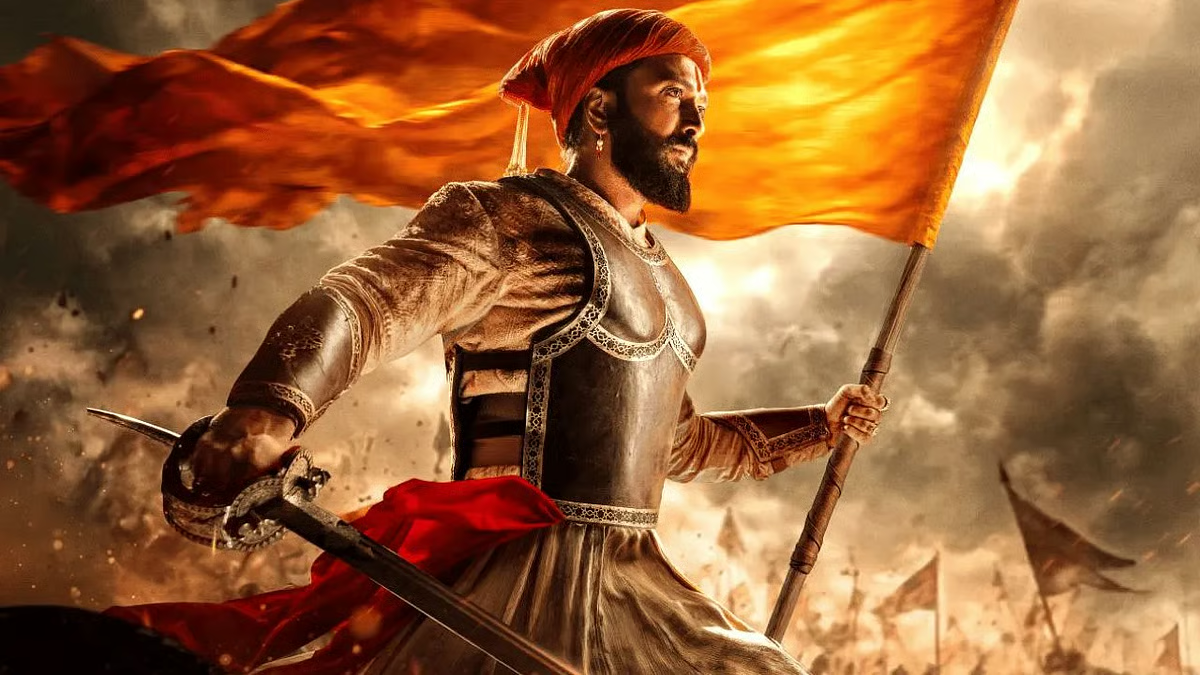
Ambition is written into every frame of Raja Shivaji, and ambition, it turns out, is both its great strength and the source of its struggles. Mounted as the most expensive Marathi film ever made and directed by Riteish Deshmukh, who also takes the title role of Chhatrapati Shivaji Maharaj, this is a sweeping, sincere and frequently stirring tribute to one of India’s most revered figures. It is also, at three and a quarter hours, a film epic in length but not always in scope, a grand spectacle that one comes to admire more than one is genuinely moved by. That it has become the highest-grossing Marathi film of all time, surpassing even Sairat, only underlines the scale of its achievement and the depth of the devotion it taps into.
Released to coincide with Maharashtra Day and made simultaneously in Marathi and Hindi on a substantial budget, the film traces Shivaji’s journey from his early years to his definitive rise, the period before his coronation as Chhatrapati in 1674. Structured across eight chapters, it begins with his childhood under the formative guidance of his mother, Rajmata Jijabai, whose teachings shape his vision and courage, and follows his struggles against the Adil Shahi Sultanate and the Mughals as he forges a loyal army, masters guerrilla warfare and pursues his mission of Hindavi Swarajya, or self-rule. The emotional spine is a tale of vengeance: the death of his elder brother Sambhaji at the hands of the Bijapur commander Afzal Khan, and his mother’s charge that he avenge it, building towards the film’s celebrated centrepiece, the legendary confrontation with Afzal Khan.
There is much to respect here. Deshmukh’s evident research and reverence for his subject lend the film a foundation of real conviction, and tellingly, he reveals a surer touch in the quieter, more intimate passages than in the grand set pieces. The standout moment is not a battle but a scene of grief, in which a tearful Shivaji returns to break the news of his brother’s death to his mother; it works because of the genuine feeling Deshmukh invests in the melodrama, and because of the gravitas Abhishek Bachchan brings, in his limited screen time, to the martyred Sambhaji. These are the moments where the film breathes, and they suggest a director more interested in human truth than the broad consensus might allow.
The performances are a decidedly mixed affair, but the highlights are considerable. The film belongs, in many of its most enjoyable stretches, to Sanjay Dutt, who attacks the role of Afzal Khan with full-blooded, scenery-chewing relish, ratcheting up his smirking villainy with every appearance. It is a broad performance, and some have found it predictable, but it supplies precisely the colour and menace the genre demands. Vidya Balan, in a smaller role as a taunting queen, is a delight whenever the camera lingers on her gleefully theatrical reaction shots, and Bhagyashree lends quiet dignity to Jijabai. Deshmukh himself is sincere and committed, though it must be said that he is not always a formidable enough presence to fully embody the near-mythic ruler at the film’s centre; the soundtrack frequently works overtime to manufacture the aura the performance does not always generate on its own.
That soundtrack is, in fairness, one of the film’s assets. Ajay-Atul deliver a rousing title song that has become genuinely popular, particularly with Marathi audiences, and the background score by John Stewart Eduri is impactful, swelling effectively through the battle and emotional sequences. The production design is of a high standard, and the sheer sweep of the locations, drawn from across the Western Ghats, gives the film a handsome, expansive canvas. There is real craftsmanship in the mounting, and for long stretches the spectacle is impressive to behold.
Where Raja Shivaji stumbles is in two crucial areas. The first is its length and pacing. At one hundred and ninety-five minutes, the film is simply too long, and it grows stretched and repetitive, leaning heavily on Swarajya monologues where dramatic momentum is needed. A sharper edit could have trimmed perhaps forty minutes and produced a tighter, more urgent film. The second, and more damaging for a project of this scale, is the unevenness of its technical execution. The visual effects and computer-generated imagery are frequently below par, the colour grading is inconsistent, and several battle scenes feel conspicuously artificial, puncturing the grandeur the film works so hard to build. For an epic that lives or dies on the believability of its spectacle, these lapses are hard to overlook.
There is, too, the matter of familiarity. The story, however stirring, is so well known that the film offers little in the way of freshness or surprise, and its characterisation tends towards the broad and the reverential, with the villainy painted in stark, one-dimensional strokes and several supporting figures left underwritten. The register throughout is devotional rather than interrogative, and viewers seeking nuance or novelty may find the film content to admire its hero rather than examine him. It is, in the end, a spectacle that soars in parts, especially towards its climax, yet remains one that impresses the eye more than it stirs the heart.
None of this has dented its remarkable commercial success, which has been concentrated, understandably, among audiences in Maharashtra, for whom the film is plainly a labour of love and pride. As a milestone for the scale and ambition of Marathi cinema, Raja Shivaji is genuinely significant, and as a heartfelt cinematic tribute, it largely accomplishes what it sets out to do.
This is a film to watch for its sweep, its music, its emotional high points and a gloriously villainous Sanjay Dutt, provided one is willing to forgive a bloated runtime and patchy effects. It is an admirable, sincere and imperfect epic, an act of devotion rendered on the grandest canvas Marathi cinema has yet attempted, even if the film inside it never quite matches the magnitude of its intentions.